Friday, 6 May 2022

Robert Aickman and Winifred Wagner

Winifred Wagner

In Robert Aickman: An Attempted Biography, I discuss the author’s admiration for the actress and film-maker Leni Riefenstahl. I show how Aickman had an uncomfortable appreciation of figures associated with Fascism, and how he was happy to overlook what might seem obvious faults if he considered them to be great artists. Riefenstahl was not the only instance of this.

In a letter to Ramsey Campbell dated 29th November 1976, Aickman wrote:

Have you seen the Winifred Wagner film? Though not up to much cinematographically, it is, as The Times said, ‘Spellbinding’.

The film is The Confessions of Winifred Wagner, essentially a five hour interview given by Wagner in 1975 to Hans-Jürgen Syberberg. Aickman is likely to have seen the 105 minute version edited for cinema release in the UK.

Wagner was an interesting woman: born in Hastings in England in 1898 and orphaned by the age of two, she was brought up in a series of Sussex children’s homes. Aged ten, she was adopted by relatives of her mother and moved to Germany. Her adopted parents were friends of Richard Wagner, the composer, theatre director, polemicist and conductor, best known for his operas.

Wagner’s son, Siegfried, ran the successful Bayreuth Festival, which had been passed to him by his father. Siegfried was secretly bisexual and it was arranged that seventeen year old Winifred Klindworth (as she was known at that time) would meet Siegfried (aged forty-five), and a year later, they married. The Wagner family hoped that the marriage would shield Siegfried and the family from scandal, and also provide heirs. Winifred and Siegfried dutifully had four children before he died in 1930, when Winifred took over the running of the Bayreuth Festival.

Siegfried and Winifred Wagner

In 1923 Winifred met Adolf Hitler, an admirer of Richard Wagner’s music, and became devoted to him. When Hitler was jailed in 1923 for his part in a failed Nazi Party coup d’état, Wagner not only sent him food parcels, but also stationery on which Mein Kampf may well have been written. In the 1930s she served as Hitler’s translator and their relationship grew so close that by 1933 there were rumours of impending marriage. The Wagner home in Bayreuth became Hitler’s favourite retreat. (He was there so frequently that after the war the Americans assumed it had been his property.)

 
Adolf Hitler and Winifred Wagner

Winifred Wagner remained personally loyal to Hitler throughout her life (she died in 1980, aged 82), and never admitted any error in their relationship. She insisted that she only ever experienced an immensely positive side of Hitler's personality, and could disassociate that from his (reported) darker side. Hitler was known in her family as 'Wolf'.

In Syberberg's film, Winifred claimed to be absolutely 'unpolitical', but she also admitted she was an ardent National Socialist. Such contradictions are a thread in the film. Another example is that at Bayreuth, Hitler was apparently able to forget affairs of state and consider only music, yet Winifred describes how great political decisions were made there. (She was excluded from her own living room when discussions took place about the exact position of Siegfried Line.)

Winifred was consulted by Hitler about important artists who might be exempted from military service. She also appears to have successfully interceded on the part of a number of Jews and homosexual men who were being persecuted. One particular letter she wrote in the late 1930s to Hitler seems to have prevented Hedwig and Alfred Pringsheim (whose daughter was married to the author Thomas Mann) from being arrested by the Gestapo. It is interesting that this letter should have surfaced when the vast majority of her two-decade long correspondence with Hitler, which has been preserved, has never been made available to researchers. One important motivation for her itercessions (which were generally successful) was to give the Bayreuth Festival access to the best artists.

 
Winifred Wagner at the train station of Bayreuth, 1941

Winifred Wagner argues at the end of the film that contemporary critics cannot possibly understand how ordinary Germans felt about Hitler at the time. Her own children, however, were able to see him for the monster he was. In 1939 Winifred's daughter, Friedeland, became an outspoken critic of Hitler and left Germany. After the war Winifred's son Wieland, a favourite of the Fuhrer, condemned Hitler. In the film Winifred refuses to admit that she did anything wrong, and even acts as an apologist for Hitler by stating that he allowed himself to be too much influenced by others around him. She also does her best to 'humanise' Hitler by offering information such as his enjoyment of 'liver dumplings, despite usually having a vegetarian diet.

After the defeat of Germany, a de-Nazification court banned Winifred from the Bayreuth Festival, the running of which was passed to her sons Wieland and Wolfgang. She complained to Syberberg that she was accused of being a 'beneficiary' of Nazism, but pointed out that her own son ended up being allowed to run 'her' festival and was therefore even more of a beneficiary, and that he was essentially ungrateful considering the favours Hitler had bestowed on him.

By the 1950s Winifred Wagner was once again a successful political hostess. Her grandson has written,

. . . the first lady of right-wing groups . . . received political friends such as Emmy Göring, Ilse Hess, Adolf von Thadden [co-founder of the National Democratic Party], Gerdy Troost, the wife of the Nazi architect and friend of Hitler Paul Ludwig Troost, the British fascist leader Oswald Mosley, the German NS-movie director Karl Ritter and the racist author and former Senator of the Reich Hans Severus Ziegler.
Gottfried Wagner, Wer nicht mit dem Wolf heult  (Cologne, 1997)


Winifred Wagner interviewed in 1975

Given his views, it is perhaps not surprising that Aickman thought the interview given by Wagner was ‘spellbinding’ (others may reasonably consider it an over-long exercise in self-justification and a display of what we would now call 'entitlement'). However, in his letter to Ramsey Campbell, Aickman also wrote:

Winifred Wagner emerges unmistakeably as a Great Soul.

It is difficult to understand this statement unless one takes Winifred's claims at face value and ignores the obvious contradictions. She insists that she was a scapegoat, and one assumes that her devotion to music and her passionate loyalty to her friend, 'Wolf', commended her to Aickman. Were these qualities, for Aickman, more important than the fact that she was devoted to the dictator responsible for World War Two, who had perpetrated the Holocaust? It is very difficult to understand in what way Aickman could have thought her ‘a Great Soul’.


The above is an expansion of material from Robert Aickman: An Attempted Biography by R.B. Russell.

Acknowledgements

With thanks to Gary Couzens, Heather Smith, and Artellus, Ltd.

All photos, unless otherwise stated, are copyright Estate of Robert Aickman/British Library/R.B. Russell, and are not to be reproduced without permission and acknowledgement. 

Thursday, 28 April 2022

Robert Aickman: The Six Best Ghost Stories


In The Third Fontana Book of Great Ghost Stories (Fontana/Collins, 1966) Robert Aickman wrote:

 
Of ‘The Beckoning Fair One’ [by Oliver Onions], it must be said that it is one of the (possibly) six great masterpieces in the field; constellated here with Algernon Blackwood’s ‘The Wendigo’ in the first collection, and Robert Hichens’s ‘How Love Came to Professor Guildea’ in the second.


Having mentioned three of the six (possible) masterpieces in the ghost story genre, Aickman tantalisingly refuses to tell us which are the other stories. It seems reasonable that they are not to be found elsewhere in the first three volumes of the Fontana books he edited (otherwise he would have mentioned them.) This rules out stories that connoisseurs of the genre might have thought strong candidates, including Walter de la Mare’s ‘Seaton’s Aunt’ and Edith Wharton’s ‘Afterward’.

It is not unreasonable to assume that the three remaining stories are to be found somewhere in Aickman's five subsequent Fontana volumes, although we must allow for the possibility that Aickman was unable to obtain copyright permission for them.

Another clue is Robert Aickman’s own library, which was catalogued after his death when it was sent to Bowling Green University. A large number of ghost story writers we know he read are not to be found among these books, so it is very possible that in his later years, having downsized from his large flat at the Barbican to smaller rooms at Gledhow Gardens, Aickman ‘pruned’ his collection. There is a strong possibility, I would argue, that he would have retained those three remaining ‘masterpieces’ on his shelves. I suggest that it is in the over-lap between the Fontana collections and his library that we will find the remaining three stories….

Possibilities from the 4th Fontana volume are:

‘The Sphinx Without a Secret’ by Oscar Wilde
‘The Wolves of Cernogratz’ by Saki
    ‘When I was Dead’ by Vincent O’Sullivan
 
from the 5th

‘The Firmin Child’ by Richard Blum
‘A Question of Time’ by Elizabeth Walter
‘The Great Return’ by Arthur Machen

from the 6th

‘Sorworth Place’ by Russell Kirk

from the 7th

    ‘Dearth’s Farm’ by Gerald Bullett
    ‘Esmeralda’ by John Kier Cross
    ‘The Visit to the Museum’ by Vladimir Nabokov
    ‘Where the Woodbine Twineth’ by Davis Grubb

from the 8th

‘Bezhin Lea’ by Ivan Turgenev

All of the above stories were in collections that Aickman retained. Of course, it is possible that he didn’t need to keep a copy of all the ‘masterpieces’ in their original publications, as they were in his own copies of the Fontana volumes.

The only story other than the initial three which Aickman called a masterpiece (actually, an ‘unqualifiable master­piece’) is Turgenev’s ‘Bezhin Lea’. It is, perhaps, the most likely addition to the list which would now comprise:

‘The Beckoning Fair One’ by Oliver Onions
‘The Wendigo’ by Algernon Blackwood
‘How Love Came to Professor Guildea’ by Robert Hichens
‘Bezhin Lea’ by Ivan Turgenev

That the remaining two are to be found in the other stories mentioned in this blog is likely, but who can say which they are…


Oliver Onions (left) and Algernon Blackwood (right)

Robert Hitchens (left) and Ivan Turgenev (right)

Wednesday, 20 April 2022

Robert Aickman and Meum Stewart


Meum Stewart from a 1921 Cigarette Card


Robert Aickman’s March 1946 article on the playwright Clifford Bax in The Nineteenth Century and After resulted in an invitation to dinner. When Aickman presented himself, however, Bax was ill and in his stead Bax had arranged for Meum Stewart,


. . . to take me out and entertain me . . . not very long before that time, Meum Stewart had been customarily referred to by much of the popular press as ‘The most beautiful woman in London’.


Aickman remembered Stewart as ‘not only the most beautiful but also the sweetest and most sensitive of women.’


Having later introduced Aickman to Bax, Meum apparently tele­phoned Aickman, seeking sympathy. He asked her out to lunch where she explained that although Bax had been attached to her for years, he had fallen in love with someone else.


Meum’s real name was Dorothy Lindsell-Stewart and she had been an artists’ model when she met Jacob Epstein (c.1916), with whom she had a child, although she was still married. By the time Aickman met her, she had enjoyed a slightly lack-lustre career in theatre and cabaret. She was twenty years younger than Bax, and twenty older than Aickman.


Meum Stewart by Bassano Ltd, 1919

Aickman’s sympathy led to their friendship, and he was asked to Meum’s eccentric ‘M Days’. These began at half past nine on a Sunday morning and took place at her impressive house at 5 Oak Hill Park, Hampstead. A man in livery admitted guests, and after signing the visitors’ book (which boasted ‘glittery signatures’), one went in to breakfast, which was of ‘the eighteenth-century type, with chops, steaks, and devilled drum­sticks’ rather than the usual post-war rations. The house was,


. . . decorated with paintings, drawings, and sculptures of Meum. They were the work of the most famous artists from all over Europe . . .


Conversation at breakfast would be dazzling, and afterwards the party moved into the garden where very intellectual games were played, many of them devised or discovered by Bax. Aickman says he was always the least eminent person present, and the youngest. He was at a loss to understand what was happening. However, he later surmised that the intention of M Days, which broke up in the early afternoon, was to enable guests to find, ‘a kindred spirit with whom to depart for an afternoon and evening of solace, joy, and inspiration’.


When Meum Stewart died in 1957, Aickman inherited her books and four drawings of her by Epstein, which he hung on his walls. He says that Meum’s solicitors forwarded a letter from her,


. . . to the effect that I had always meant more to her than I had seemed to realise.


Meum Stewart’s bookplate


Robert Aickman: An Attempted Biography, by R.B. Russell, Tartarus Press, 2022

Acknowledgements

With thanks to Heather Smith, and Artellus, Ltd.

All photos, unless otherwise stated, are copyright Estate of Robert Aickman/British Library/R.B. Russell, and are not to be reproduced without permission and acknowledgement.

Thursday, 7 April 2022

Robert Aickman and Picnic at Hanging Rock

Original film poster for Picnic at Hanging Rock

On the 29th November 1976, Robert Aickman wrote to Ramsey Campbell:

Very many thanks for recommending Picnic at Hanging Rock. Despite a certain naivete in the direction, it is a very good film indeed, and, I should say, in important respects unique. It is indeed also a quite remarkable simulacrum of my methods: not only my type of theme (I have never seen any other film like it), but also in the proportions maintained between the mysterious and the familiar. Who, please, is Joan Lindsay, who wrote the book? I have never heard of her, and should like to read it. I take it that the film is based on something that actually happened? I supposed that it was, but was then made to wonder by the comprehensiveness of the intimation at the end that no character in it was based on any real person, living or dead. Perhaps as a critic you have received documentation that answers this question? In fact, I should be most interested to see any documentation you may have. It is a most extraordinary film: most like me are the unexplained accessories, the lady who had lost her skirt, and the girl who makes the unexplained return.

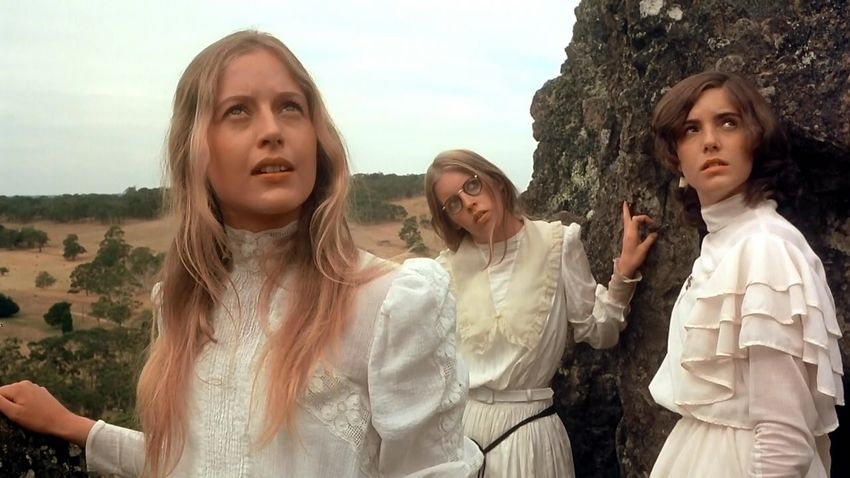
Picnic at Hanging Rock, made in 1975 in Australia, was directed by Peter Weir. It was adapted, quite faithfully, from the 1967 novel of the same name by Joan Lindsay.

It is difficult not to offer a major ‘spoiler’ for the film, but I hope this won’t put anyone off seeing it, if they haven’t already. On Valentine’s Day 1900, the students at a private school for girls in Victoria, Australia, go with their teachers to picnic at a local geological formation known as Hanging Rock. (It is a real place.) Later, with permission, four girls explore the rock, but, near the summit, next to a monolith, they mysteriously fall asleep. When they awaken, all but one, Edith, move further into the rock formation. Edith runs away in terror. When the party returns to the school, three girls and one teacher are missing. Much later, one of the missing girls, Irma, is recovered, but she cannot explain what happened to her, or to her friends and teacher.

Still from the 1975 film Picnic at Hanging Rock
 
The film has been long regarded as a classic, although there have always been dissenters who are annoyed that the fate of three characters is never explained. The critic Roger Ebert called it ‘a film of haunting mystery and buried sexual hysteria’. It is beautifully and languorously filmed, and the sexual undertones are handled with admirable restraint.

Aickman may sound a little self-important in saying that the film is a simulacrum of his methods and that its devices are like his, but the similarities are remarkable, especially the ‘unexplained accessories’. Peter Weir succeeds in creating an Aickmanesque film not least because of the several mysteries that he refuses to resolve.

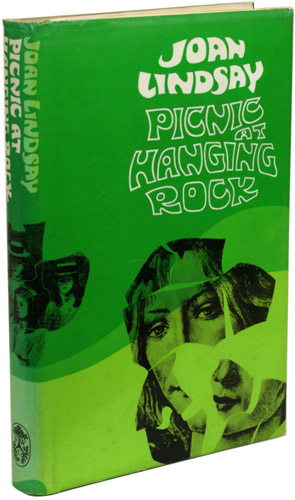
First edition of Picnic at Hanging Rock, F.W. Cheshire, Melbourne,1967
 
The film is very faithful to the book by Joan Lindsay, who deserves credit for writing an excellent novel. It is highly unlikely that she was aware of Aickman’s stories when she wrote Picnic at Hanging Rock, which was first published in 1967 in Australia. (It was reprinted by Penguin in the UK in 1975.) The idea of leaving the mystery unresolved was, in fact, not Lindsay’s own. It would appear that the original draft of the book included a final chapter that explained everything. At the suggestion of her editor, Sandra Forbes, Lindsay removed the final chapter, which, of course, only led to some readers wanting to know what it contained. Perhaps unwisely, ‘Chapter Eighteen’, as it is known, was published posthumously in 1987 as The Secret of Hanging Rock. Admirers of both the book and the film are advised not to read it!

Still from the 1975 film Picnic at Hanging Rock
 
As for Aickman’s question as to whether it was based on a real event, the answer appears to be no, even though the novel is written in the form of a true story, with a pseudo-historical prologue and epilogue. The setting and several towns mentioned exist, and the school is based on a real one (located elsewhere), but there is no record of any such events occurring. Aickman may well have admired Joan Lindsay’s refusal in interviews to either confirm or deny whether it was based on fact. In a 1974 interview she said, ‘It was written as a mystery and it remains a mystery.’

In this spirit, it is suggested that apart from The Secret of Hanging Rock, admirers might also want to keep away from The Murders at Hanging Rock, 1980, a book of hypothetical solutions by Yvonne Rousseau.


Robert Aickman: An Attempted Biography, by R.B. Russell, Tartarus Press, 2022

Acknowledgements

With thanks to Heather Smith, and Artellus, Ltd.

All photos, unless otherwise stated, are copyright Estate of Robert Aickman/British Library/R.B. Russell, and are not to be reproduced without permission and acknowledgement.

AI: Divide and Conquer

    Art the old-fashioned way I admit I am a little obsessed by the problem of AI, not least because I am an author of fiction and non-ficti...