Monday, 28 March 2022

Robert Aickman and Lord Alfred Douglas

In 1943 Robert Aickman and the photographer Howard Coster came up with a scheme  to publish a book of one hundred photographs (by Coster) and one hundred biographical notes (by Aickman) of ‘the leading men of our time in all walks of life’.

This project enabled Aickman to obtain an introduction to Harry Price (the ghost hunter), and possibly other notable figures. It also meant that he met Lord Alfred Douglas, known as 'Bosie', the controversial lover of Oscar Wilde in the decadent 1890s. Wilde was one of Aickman's heroes, and he would later lecture on the subject of Wilde.

Aick­man wrote to Douglas to ask for a meeting, and they exchanged a dozen letters thereafter, discussing theatre and literary matters. Aickman later wrote to Rupert Croft-Cooke (after the publication of Bosie: Lord Alfred Douglas, His Friends and Enemies, 1963):

I knew Lord Alfred Douglas fairly well in his last years. At about the time of his seventieth birthday, I organised a small luncheon party, mainly in order that Howard Coster, who was a friend of mine, could photograph him. After the luncheon, we all returned to Douglas’s flat. Coster and Douglas entered, in order that Coster could entice Douglas into natural attitudes etc., while the rest of us waited outside in the Gardens. After about an hour, Coster emerged and said all was well. The rest of us went in and there was one of those tea parties. About three days later Coster rang me up saying he had sent proofs to Douglas who had replied in a fury that the photographs must never be published and that the plates must be destroyed. Coster did destroy the plates, but not before he had run off a set of prints, which I still have.

Aickman’s set of photographs are kept at Bowling Green University Library with the constraint that they are not to be published or reproduced—a restriction set by Aickman himself based on Douglas's dislike of them. However, the same set, taken by Coster in Douglas’ flat in the 1940s, is available to view at the National Portrait Gallery, London, and on their website.

It can only be assumed that 'Bosie' was unhappy with the way he looked, having once been compared by Wilde to 'Hyacinthus, whom Apollo loved so madly'. Bosie in fact seems to have worn very well, but even at seventy years of age, vanity still played its part.


Robert Aickman: An Attempted Biography, by R.B. Russell, Tartarus Press, 2022

Acknowledgements

With thanks to Heather Smith, and Artellus, Ltd.

All photos, unless otherwise stated, are copyright Estate of Robert Aickman/British Library/R.B. Russell, and are not to be reproduced without permission and acknowledgement.

Monday, 21 March 2022

Robert Aickman: 'Eve' at Baldslow Windmill

 
‘Eve’ and Robert Aickman

One of Aickman’s ‘great loves’ (there were several), was a woman he called Eve in The Attempted Rescue, whom it has not yet been possible to identify. Aickman wrote that they moved into a disused windmill at Baldslow, north of Hastings, Sussex, just before the start of the Second World War. He happily recalled Eve, in trousers, on a succession of sunny days.


Aickman retained a number of photos of himself and ‘Eve’ (identified by Felix Pearson in the Aickman archive). The one reproduced above looks uncannily like a wedding photograph!
 
Aickman wrote in The Attempted Rescue, that two years of rare happiness ended at Baldslow:
 
Eve had died for me when she accommodated to the unnecessary war. Possibly I had died for her a little earlier; when I failed to perform the miracle that all women need.
 
As is often the case with Aickmans autobiographical assertions, he raises more questions than he answers. Why was the Second World War unnecessary? (His claim was made in 1966, long after most historians agreed appeasement with Hitler would been impossible.) What was the miracle he had failed to perform? (Should one even ask?) 
 
It is also easy to read Aickmans account and assume that when he moved to Baldslow Windmill with Eve they were together there, perhaps alone, for a significant period of time. However, in a letter to Audrey Linley on 12th April 1940, Aickman wrote that during the summer of 1939, ‘I spent . . . three weeks in a windmill which I leased with some friends.’ Aickman kept photographs of himself and Eve, along with one of the Windmill which shows Eve and those friends, including children.

‘Eve’ seated, and others at Baldslow Windmill. Photo taken by Aickman?

    
Baldslow Windmill today
 
As is often the case, Robert Aickmans version of events in The Attempted Rescue is a very personal one, offering a perspective that suited the story he wished to tell.

 
The above is an expansion of material from Robert Aickman: An Attempted Biography by R.B. Russell.

Acknowledgements

With thanks to Heather Smith, and Artellus, Ltd.

All photos, unless otherwise stated, are copyright Estate of Robert Aickman/British Library/R.B. Russell, and are not to be reproduced without permission and acknowledgement. 

Tuesday, 15 March 2022

The Beetle: The Film

Richard Marsh’s 1897 novel The Beetle is a rip-roaring thriller narrated from four different points of view. In the first, Robert Holt, down on his luck, enters an abandoned house and meets the mysterious Beetle. It takes control of his mind through mesmerism, sending him to the home of Paul Lessingham to steal some letters. After an altercation, Holt escapes and delivers the letters to the Beetle, who discovers them to be love letters from Marjorie Lindon. The Beetle intends to use her to harm Lessingham . . .

The narrative then switches to the point of view of Atherton, Paul Lessingham’s rival for Marjorie’s affections. And so the novel continues, hectic and convoluted with the Beetle causing all kinds of mayhem, through to the final narrative which is told from the perspective of Detective Augustus Champnell. Lessingham tells the detective the background to his troubles with the Beetle: twenty years previously he had travelled to Cairo, where he was lured by a young woman and captured by the cult of Isis. In her temple, Lessingham had been hypnotised and forced to obey the orders of the high priestess, in which state he had witnessed many sacrifices of women. When the control over him weakened, he took the opportunity to attack the high priestess, strangling her until she turned into a scarab.

And so the story rattles on to the final chapters which would have continued to thrill its Victorian readers. I will not provide a “spoiler” for the book, although I will say that the final scene involves a railway pursuit that ends ‘somewhere in the neighbourhood of Luton’.

 
Maudie Dunham and Hebden Forster

The Beetle was reprinted many times, and in 1919 it was made into a silent movie. A “B.M.P.” production, in “five reels”, it was directed by Alexander Butler, and starred:

Hebden Foster as Paul Lessingham
Fred Reade as Sidney Atherton
Rolfe Leslie as Richard Holt
Leal Douglas as The Priestess of Isis
Fred Morgan as Necos the High Priest
Maudie Dunham as Dora Greyling
and Nancy Benyon as Marjorie Lindon

A still from The Beetle, 1919

As with many movies inspired by popular books, the film makers took some liberties. The central premise is very similar, but the conclusion is more cinematic. Here is a description of the action from a promotional brochure: After the High Priest, in the form of the Beetle, kidnaps Marjorie,

". . . he flies with her to Egypt.
Lessingham, reeling under the strain of ill-health, is stunned at this new blow for he realises that Marjorie will be sacrificed to the Goddess whose life he took.
He confides in Sidney Atherton and they catch the first mail boat to Northern Africa.

A still from The Beetle, 1919

"The irrepressible Dora has, however, discovered the details of Marjorie’s whereabouts and chartering an aeroplane arrives in Cairo before the men. She equips an expedition to the hidden Temple and on the arrival of Lessingham and Atherton they set out. They are only just in time. In a tumult of wild fighting and destruction the worshippers of Isis are overcome, Marjorie is rescued and the Temple destroyed. But the Beetle remains. Dora and Sydney among the ruins of the Temple suddenly see the Beetle—the transmigrated soul-mate of Lessingham’s past—arise from the debris; it is the work of a moment for Dora to blast the Beetle and the Curse with her revolver and remove the cloud for ever from the lives of her friends."

 
A still from The Beetle, 1919

The above is a blatant “spoiler” for the film version, but as the film is lost and can not be seen, I hope I will be forgiven. A brochure for the film is in the Robert Aickman archive in the Britsih Library, and may be the only existing copy. Online databases such as IMDB have very little information about the film.

 
The above is an expansion of material from Robert Aickman: An Attempted Biography by R.B. Russell.

Acknowledgements

With thanks to Heather Smith, and Artellus, Ltd.

All photos, unless otherwise stated, are copyright Estate of Robert Aickman/British Library/R.B. Russell, and are not to be reproduced without permission and acknowledgement.

Wednesday, 9 March 2022

Ray Aickman

 
Ray Aickman

Edith Ray Gregorson, known as Ray, was born in 1914 (the same year as Robert Aickman), and was introduced to Robert by a mutual friend, Audrey Linley. Robert and Ray started a relationship ‘based more on their intellectual interests than on any genuine feeling for each other’, according to David Bolton (The Race Against Time). Elizabeth Jane Howard remembers Ray as working at this time as a private secretary to the playwright, Ronald Jeans, although by 1941 Ray was employed by the literary agents World Press Features Ltd as secretary to the editor, Donald Kitchin.

Ray and Robert’s apparent ‘marriage of convenience’ took place on 5th September 1941 at the Hendon Registry office. Robert wrote to Audrey Linley, ‘explicitly stating that he had not married for love, but out of sympathy’. Ray told Elizabeth Jane Howard that they had only married to stop Ray being called up.

 
Robert and Ray Aickman, Huntingdon, c. 1940s

Together with Howard and Joan Coster, Robert and Ray founded the Richard Marsh Ltd Literary Agency, which appears to have operated from as early as July 1941, and acted on behalf of a number of writers, including the Revd Awdry, author of the very successful ‘Railway’ books. Aickman was later to write about some of the agency’s clients, but did not mention Awdry, perhaps because he had little interest in books for children. This might  partly account for Aickman not mentioning the successful sale of two books for children written by Ray herself, Lemuel (1947) and Timothy Tramcar (c.1950). However, Aickman seems to have had other reasons for cutting his wife from his autobiographical writings.

 
Lemuel (1947)

 
Timothy Tramcar (c.1950)

Audrey Linley commented that Aickman apparently ‘deplored marriage for its “Noah’s Ark aspect”—the fact that married couples were expected to appear everywhere together’. But his prejudice was stronger than this. In his autobiographies, as well as other accounts, he edited out all references to his marriage to Ray. This was despite Ray playing an important (and unsung) role in the running, not just of their literary agency, but also of the Inland Waterways Association. Her administration skills were essential and much admired. Furthermore, Ray was at Aickman's side on many of their early cruises on the waterways and related events.

Robert and Ray Aickman were divorced in 1957, which surprised many who knew the couple well. Even more surprising was that in the same year Ray entered a convent, All Saints, at London Colney, taking the name Sister Benedicta. Aickman was furious at this turn of events and did everything he could to dissuade her. When it was clear she had made up her mind, Robert broke off all relations with her. When he came to write The River Runs Uphill, he made absolutely no reference to his ex-wife.

Ray remained with the Convent of All Saints for the rest of her life, moving to Oxford with the mother house when the Colney property was sold to the Roman Catholics. She died of cancer in 1983, and is still fondly remembered there. She was hard working, and later, when her organisational skills were recognised, she was essential to the management of the convent. Her life was not entirely given to God, However. A friend from this time, Mike Garside, recalled Ray 'attending the AGMs of the Slimbridge Wildfowl Trust in full religious dress. She would arrange for her holidays from the convent to coincide with the event.'

The above is an expansion of material from Robert Aickman: An Attempted Biography by R.B. Russell.


Acknowledgements

With thanks to Heather Smith, and Artellus, Ltd.

All photos, unless otherwise stated, are copyright Estate of Robert Aickman/British Library/R.B. Russell, and are not to be reproduced without permission and acknowledgement.

Tuesday, 1 March 2022

William Arthur Aickman, Architect


William Arthur Aickman

Robert Aickman’s father, William Arthur Aickman, was born in King’s Lynn in 1859. He was the eldest of six children (five brothers and one sister) and became an architect, practicing between 1870 and 1938 from three central London offices, beginning at 34 & 36 Gresham Street. He was successful for many years, receiving important and lucrative commissions from, among others, H.H. Finch Ltd, owners of wine-shops and public-houses.


London Spa, 2006

One example of William’s work that can still be seen today is London Spa Court on the junction of Rosoman Street and Exmouth Street in Clerkenwell, which he remodelled with J.K. Bateman in a ‘Wrenaissance’ style. Robert later hung a drawing of the London Spa (as it was originally called) in his Gower Street flat, proud to report that it had been shown at the Royal Academy and displayed at the Chicago World Fair. Other examples of William Aickman’s work were large private houses at Cobham, Surrey for Mr Hasloch (‘Round Close’, which still stands, and ‘Broom Close’, finished c.1907, now demolished.)

 
Bridle Way, Ewell, Surrey by William Arthur Aickman. From the Studio International Yearbook, 1908

 
House at Northwood, by William Arthur Aickman. From The Studio Yearbook, 1910

His work was featured in The Studio and The Builder, and Robert pointed out that it was later commented on kindly by John Betjeman. (I have not been able to find a reference for this—it may have been a personal comment.) William Aickman’s work was of its time, and in aesthetic terms his smaller houses (e.g. ‘Bridle Way’, Ewell) are much more elegantly proportioned than the larger ones (e.g. ‘Middle Hill’, Hook Heath).

Middle Hill, Hook Heath, Surrey by W.A. Aickman. From the Studio Yearbook, 1907

 Broomclose by W.A. Aickman. From the Architect, 1907

 Robert Aickman memorably pronounced that after 1914 his father ‘was essentially a refugee’. William Aickman had previ­ously relied on lucrative commissions for large country houses designed to be run by a number of domestic servants, but the demand for such houses promptly declined. As a result William had to leave his beloved office in Gresham Street. ‘He was even reduced to the surveying of basements and cellars for possible use as air-raid shelters,’ reported his son. The architec­tural business was relocated to the top floor of 39 Bloomsbury Square, and later to the first floor at 58 Gordon Square. Apart from the lack of commissions, from the beginning of the war William Aickman found it increasingly difficult to employ reliable staff.

Robert Aickman suggested that he had himself under­taken some architec­tural training, but this does not seem to have been at all formal, as elsewhere he only admitted to helping with jobs like measur­ing premises with his father, and office administration. His father’s inability to keep appoint­ments meant that Robert had to act on his behalf at such meetings as those with the licensing authorities. Generally, Robert spent time at his father’s office struggling with corres­pondence and telephone enquiries, ‘without authority, without knowledge, but not always without success’.


The above is an expansion of material from Robert Aickman: An Attempted Biography by R.B. Russell.


Acknowledgements

With thanks to Heather Smith, and Artellus, Ltd.

All photos, unless otherwise stated, are copyright Estate of Robert Aickman/British Library/R.B. Russell, and are not to be reproduced without permission and acknowledgement.

Tuesday, 22 February 2022

Robert Aickman and Gabriele D’Annunzio

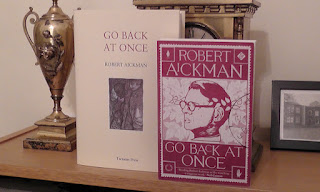
Go Back at Once, published by Tartarus Press (2020) and And Other Stories (2022)
 
In Robert Aickman’s novel Go Back at Once, the enigmatic and shadowy Virgilio Vittore personally annexes the Adriatic state of Trino and governs it ‘according to the laws of music’. Aickman sends his three female characters there from London, which proves to be an exciting, anarchic and surreal experience. Arguably, this is the best part of the book, where the author is able to explore a fantasy that was close to his own heart: the establishment of a society with the Arts at its centre. It is run by an ‘enlightened’ individual, rather than a bothersome democracy.

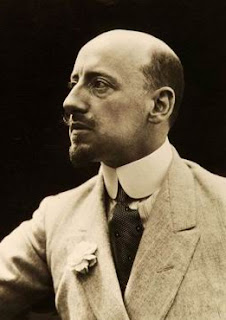
 Gabriele D’Annunzio, Comandante of the Carnaro

Vittore was based on the Italian poet and author Gabriele D’Annunzio (1863-1938), regarded in his home country as a war-hero, and who, in 1919-1920, as a part of the Italian nationalist reaction against the Paris Peace Conference, set up the short-lived Italian Regency of Carnaro in Fiume (now Rijeka in Croatia). D’Annunzio entered the city with only a handful of soldiers and proclaimed himself Duce.

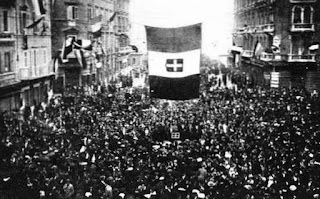
Fiume residents cheering D’Annunzio and his soldiers, September 1919

D’Annunzio (with cane) with legionaries in Fiume in 1919.

In Carnaro, D’Annunzio wrote the constitution, and Aickman quoted approvingly, ‘ “In the Regency of the Carnaro, music will be a religious and social institution”.’ D’Annunzio never called himself a fascist, but he is considered the forerunner of Italian fascism because his ideas and aesthetics were highly influential on Benito Mussolini. Aickman himself did not believe in democracy—he was an unashamed elitist, certain that some were born to rule over the majority. In Virgilio Vittore, Aickman offers us an example of how he believed an enlightened country could be run.

1920 25c stamp from Fiume

D’Annunzio would have felt vindicated when the independent Free State of Fiume was created by the Treaty of Rapallo on 12th November 1920, but he overplayed his hand. He ignored the Treaty and declared war on Italy itself. In retaliation, the Italian army attacked Fiume on 24th December, and the Royal Italian Navy commenced a bombardment. After five days of fighting, known as ‘Bloody Christmas’, the Fiuman legionnaires evacuated and on 29th December surrendered. The Free State of Fiume, however, lasted officially until 1924, when it was formally annexed to Italy under the terms of the Treaty of Rome.

Despite declaring war on his own country, D’Annunzio was able to retire to his home on Lake Garda where he spent his remaining years writing and campaigning. Although he influenced the ideology of Benito Mussolini, he was not directly involved in Italian fascist government politics. In 1922, he fell out of a window (it is not known if he was pushed), and was badly injured. He was ennobled by King Victor Emmanuel III in 1924 and given the hereditary title of Prince of Montenevoso. In 1937 he was made president of the Royal Academy of Italy, and when he died in 1938 (of a stroke) he was given a state funeral by Mussolini.


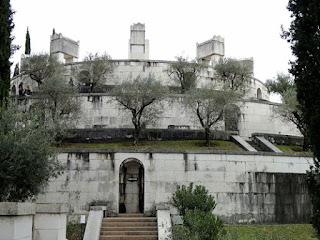
Mausoleum of Gabriele D’Annunzio, at the Vittoriale degli italiani, in Gardone Riviera, on Lake Garda, Brescia, Italy. Photo by Daderot.

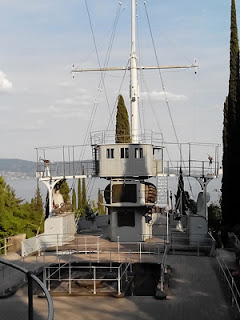
D’Annunzio’s remains were interred in a grand tomb constructed of white marble at Il Vittoriale degli Italiani (the shrine of victories of the Italians) at a hillside estate in the town of Gardone Riviera, overlooking Lake Garda. It is where he lived after his defenestration until his death. The estate includes his residence (the Prioria), an amphitheatre, D’Annunzio’s cruiser Puglia set into a hillside, a boathouse containing the torpedo-armed motorboat used by him in 1918 and a circular mausoleum. The Vittoriale is described variously as a ‘monumental citadel’ and a ‘fascist lunapark’.

Jutting out of the hilltop at at the Vittoriale degli italiani, the bow of the D’Annunzio’s cruiser Puglia. It points in the direction of the Adriatic, ‘ready to conquer the Dalmatian shores’. Photo: Federica Pinelli.

Robert Aickman travelled extensively in Europe after the Second World War, until his death in 1981. As he is known to have visited Mussolini’s tomb, it seems quite likely that he would also have visited Gabriele D’Annunzio’s Mausoleum.
 
 
The above is an expansion of material from Robert Aickman: An Attempted Biography by R.B. Russell.


Acknowledgements

With thanks to Heather Smith, and Artellus, Ltd.

All photos, unless otherwise stated, are copyright Estate of Robert Aickman/British Library/R.B. Russell, and are not to be reproduced without permission and acknowledgement.

Thursday, 17 February 2022

Robert Aickman: Second World War and Conscientious Objection

 
St Paul's Cathedral, from Paternoster Row, WWII

Robert Aickman reported that he had been a Conscientious Objector during the Second World War, claiming that he had made such a good argument before a Tribunal that he was exempted from any kind of war work. Friends like Elizabeth Jane Howard took this at face value and have repeated the assertion in their memoirs and recollections. I have to admit that, personally, I had always been a little sceptical, not least because Aickman’s claims about himself in his autobiographies and elsewhere are not always to be relied upon.

The main reason to doubt his word is that in his unpublished philosophical tome Panacea, Aickman wrote positively about the First World War. Many historians look back on ‘The Great War’ as a political escapade that had unforeseen consequences (none foresaw the huge loss of life over so many years). In Panacea, Aickman did not give any impression of being a pacifist (as far as he was concerned, the First War had been an aid to progress, and the death toll doesn’t seem to have been an issue for him). His main objection to the Second World War, expressed in letters to friends, was that it was ‘unnecessary’, even ‘silly’, and he appears to have believed that negotiation with Hitler would have made him go away. Most of Aickman's recorded comments were made with the benefit of hindsight.


I was also sceptical that Aickman could have been exempted from all war service by a Conscientious Objection Tribunal. In London, only 2% of all COs were given complete exemption, and most of those argued from a position of strong Christian conviction. Panacea shows that Aickman had an interest in religion, but no religious beliefs.


With an apparent lack of proof either way (most CO Tribunal records have been lost or destroyed) I discussed a number of possibilities with Aickman’s surviving friends (none of whom remember him expressing Pacifist or religious convictions). One possibility was that he had been made to do something dull and clerical, or even demeaning (in his estimation). Another possibility was that he had been sent to prison for refusing to help the war effort (although this would have been only for a few weeks, at most.) His various hints that he had talked to psychologists or psychiatrists suggested that he may have even been considered psychologically unfit. One friend considered that he may have done secret war work that he could not reveal (the CO claim being a cover story), but I thought that it would have been uncharacteristic of Aickman not to have later alluded to such a role.


The mystery was solved almost by accident, but as seems appropriate, it resulted in yet another mystery. Rosalie and I were visiting the Aickman collection at the British Library during Covid restrictions and we were only permitted to see a limited number of items. We had been perplexed by the description of one of these as Aickman’s application for a position in the Civil Service. This seemed uncharacteristic of Aickman, and piqued our interest. It was, in fact, a mis-description of his Conscientious Objection papers, including his statement to the Tribunal, which he had kept. . . .


. . . Robert had indeed registered as a CO, and had been given a full exemption, exactly as he claimed. Quite how you view the arguments he makes in his Statement depends on your own attitude towards both conscientious objection, and how Aickman presented him­self to the Tribunal. The statement is included as an Appendix to the newly published biography, so the reader can make up their own mind.


Robert Aickman: An Attempted Biography by R.B. Russell is available now.


Acknowledgements

With thanks to Heather Smith, and Artellus, Ltd.

All photos, unless otherwise stated, are copyright Estate of Robert Aickman/British Library/R.B. Russell, and are not to be reproduced without permission and acknowledgement.

AI: Divide and Conquer

    Art the old-fashioned way I admit I am a little obsessed by the problem of AI, not least because I am an author of fiction and non-ficti...